Summary
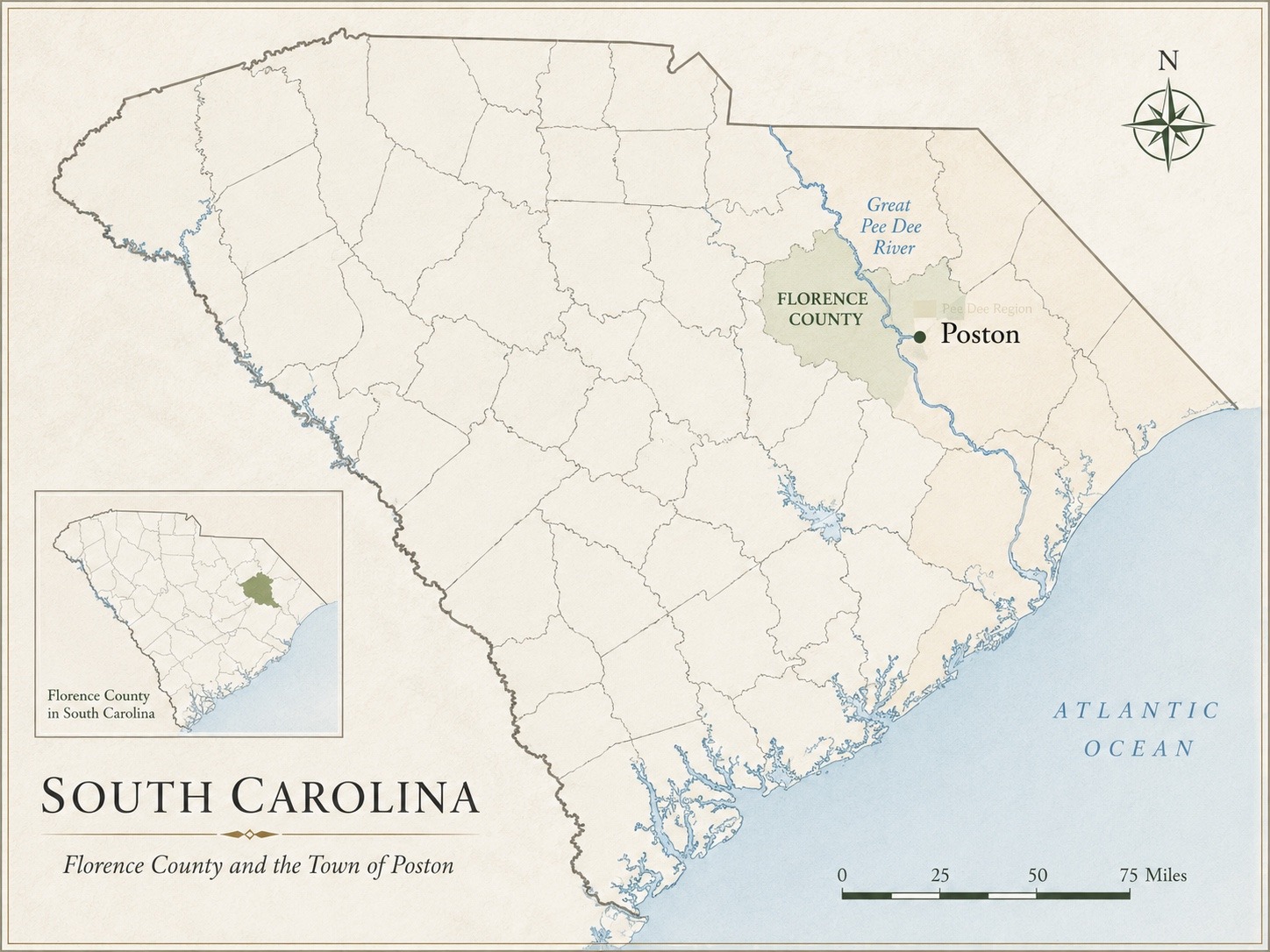
Poston, South Carolina is best understood as a layered place. The oldest layer is the Great Pee Dee River landscape and the Ellison / Allison landing locality. The second layer is the railroad-era junction that placed the Poston name into public geographic use. The third layer is the surviving rural community and documentary memory of a place that once held greater transportation importance.
Ellison and the River Locality
Before the modern Poston name became attached to the community, the locality was associated with Ellison, Ellison’s Landing, Allison Landing, and Poston Landing. These names reflect a river-centered geography: access to the Great Pee Dee River, agricultural movement, transportation, ferrying, and landing-based commerce.
The South Carolina Department of Natural Resources identifies Allisons, Ellisons, or Poston Landing as a public access site on the Great Pee Dee River at the end of Allison Landing Road in Florence County. That public river-access record is one of the clearest independent anchors for the layered naming history of the place.
The Railroad Transformation
In the early twentieth century, rail service transformed the older river locality into a more visible railroad-era community. The railroad did not create the river landscape from nothing. It overlaid a new transportation system, a new junction identity, and a new public place-name onto an older Pee Dee locality.
The Andrew Poston Connection
Andrew Poston is the strongest documented namesake figure. The 1916 newspaper notice concerning his death stated that the town of Poston on the Seaboard Air Line was named for him and that he gave land to the railroad so that “Poston might be Poston.” That source supports describing him as the best-supported namesake figure, while avoiding the stronger unsupported claim that he created the older river settlement from wilderness.
Survival of the Name
Poston did not become a large town, but the name survived. It remains attached to a Florence County place, a river landing memory, local roads, railroad-era references, family histories, and the documentary record preserved in books, newspaper archives, maps, and public databases.